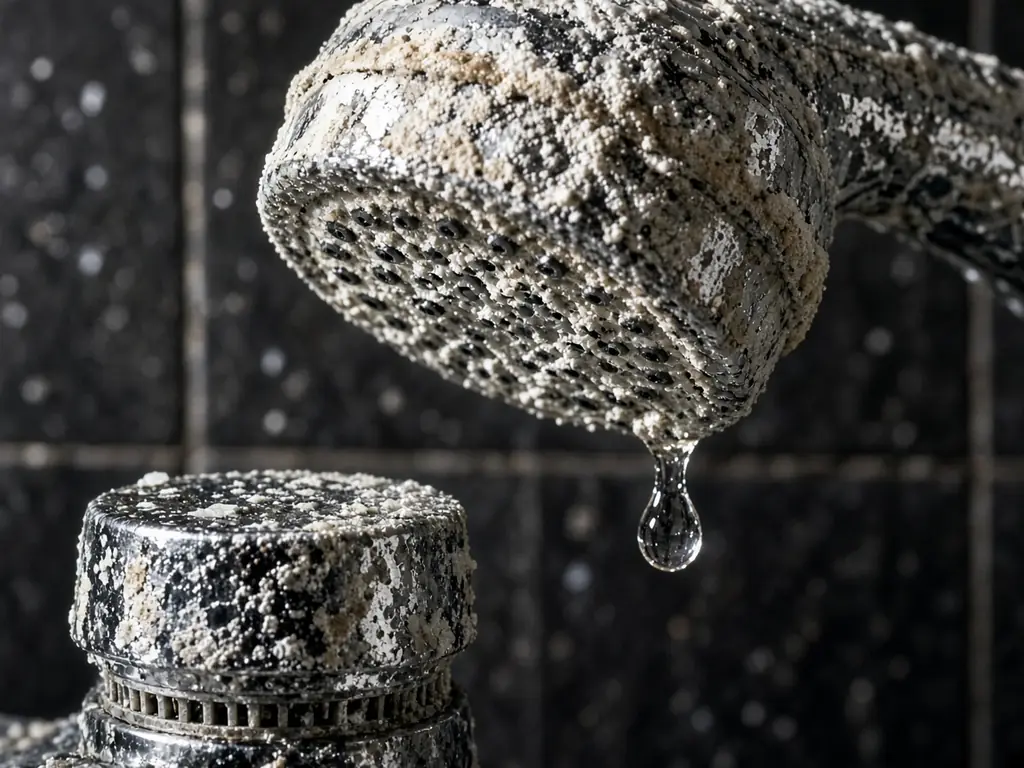
If you've lived in Winona for a while, you know the signs: white crust on faucets, spots on glasses, a shower head that sprays sideways. That's hard water. Here's what the numbers say and how to decide whether a softener is worth it for your house.
How hard is Winona's water?
- The City of Winona says its water hardness is 14 grains per gallon (220 parts per million). It's the number the city gives people setting up a water softener.
- Winona's water comes from deep wells, eight of them between 489 and 1,077 feet, drawing from the Mt. Simon and Eau Claire-Mt. Simon aquifers, according to the city's 2025 Water Quality Report. Groundwater picks up calcium and magnesium on its way through rock, which is why well water tends to be hard.
- For scale: the Minnesota Department of Health says that if your water is harder than 7 grains per gallon (120 mg/L), you might want a softener for your appliances and for how your water looks and tastes. Winona's city water is about twice that.
- The U.S. Geological Survey calls anything over 180 mg/L "very hard."
Some third-party sites list a higher number for Winona. Hardness can vary, so before you set up a softener, test your own tap with a test strip, or ask the water department. On a private well outside town, your number could be quite different, so test it.
What hard water does in your house
Per the Minnesota Department of Health, softening:
- Prevents scale buildup inside pipes, fixtures, and water heaters
- Can lengthen the life of some appliances
- Cuts down on spots on glassware
- Reduces soap film in sinks, tubs, and washing machines
Scale in a water heater is the one that costs real money, because it builds up in the bottom of the tank and on electric elements. See Signs your water heater is about to fail.
The trade-offs (honest version)
MDH also lists the downsides:
- Sodium. A salt-based softener adds sodium to your water. Winona's report already lists sodium at 39.2 ppm and notes that home softening can raise it. If anyone in the house has high blood pressure or is on a low-sodium diet, MDH suggests talking to a doctor. You can keep one unsoftened tap for drinking and cooking, or use potassium chloride instead of salt.
- Salt in the river. The chloride from softener regeneration goes down the drain, and treatment plants aren't built to remove it. MDH calls chloride a growing problem in Minnesota waters. That's a real consideration in a river town.
- Maintenance. A softener needs salt, a correct hardness setting, and occasional service. If it's set harder than your water actually is, it wastes salt and water.
- New copper plumbing. MDH says to hold off on softening for the first few weeks so the pipes can form a protective layer.
Getting it right
- Soften only what you need. MDH notes that many homes soften the showers, sinks, and laundry, and leave toilets, outdoor spigots, and basement taps on hard water. Some soften only the hot water.
- Set it to your real hardness. Use your test result, not a guess.
- Size it to your household. A unit that's too small regenerates constantly and uses more salt.
- Consider a high-efficiency unit that regenerates based on how much water you actually use, not on a timer.
Filters are a different thing
A softener handles hardness. If your concern is taste, chlorine, or something specific in the water, a filter or a reverse osmosis system at the kitchen sink may be the right tool, sometimes along with a softener. Start with a test.
Want your water tested, or a softener installed or serviced? Backwater Plumbing & Water Conditioning (MN Lic. PC150374) serves Winona and nearby towns. Call or text (763) 273-6421.
Sources
- City of Winona FAQ, water hardness 14 grains / 220 ppm: winonamn.gov
- City of Winona 2025 Water Quality Report (wells, aquifers, sodium 39.2 ppm, softening note): winonamn.gov
- Minnesota Department of Health, Home Water Softening FAQ: health.mn.gov
- U.S. Geological Survey, Hardness of Water: usgs.gov